Luxury Phinisi vs. Catamaran: Which Bali Charter is Best?
- Phinisi: Unmatched for deck space, historical romance, and large-crew service.
- Catamaran: Excels in speed, stability under sail, and accessing secluded coves.
- The Choice: Depends on whether your priority is the grandeur of a floating villa or the nimble freedom of a modern voyager.
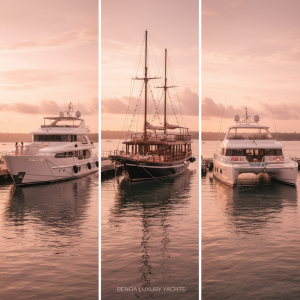
The tropical air hangs heavy and warm, thick with the scent of frangipani and clove from the shore. You stand on the docks of Benoa Harbor, the rhythmic lapping of water against the pier a gentle metronome for your decision. To your left, a magnificent two-masted vessel rises, its dark timber hull and traditional rigging a silhouette against the rising sun. To your right, a sleek, white twin-hulled craft sits low and wide on the water, its lines promising speed and precision. This is the essential question for any discerning traveler planning to explore the Indonesian archipelago: the soulful heritage of a Phinisi or the modern performance of a catamaran? As an editor who has spent countless weeks navigating these waters, I can tell you the answer isn’t about which is better, but which is distinctly you.
The Soul of the Archipelago: Understanding the Phinisi Legacy
To step aboard a Phinisi is to step into a living piece of history. These are not merely boats; they are the seafaring legacy of the Konjo people from South Sulawesi, a boat-building tradition so profound it was inscribed on UNESCO’s list of Intangible Cultural Heritage of Humanity in 2017. Originally crafted as cargo vessels to ply the treacherous Spice Routes, their design has been masterfully adapted for luxury tourism. A true Phinisi features seven sails spread across two masts, a configuration that has remained largely unchanged for centuries. Today’s luxury iterations, like the 65-meter Lamima or the impossibly chic Prana by Atzaró, merge this ancient form with 21st-century opulence. The construction process itself is a ritual, built by hand on a beach without formal blueprints, relying on generations of passed-down knowledge.
The primary advantage of the Phinisi design is its sheer volume. These vessels are, in essence, floating private estates. Their heavy ironwood or teak hulls provide immense stability, not from a wide beam like a catamaran, but from sheer displacement. This results in a gentle, predictable motion at sea, a calming sway rather than a sharp roll. Onboard, this translates to expansive, multi-level decks offering an abundance of space for dining, lounging, and yoga. It’s common for a 50-meter Phinisi to offer over 400 square meters of usable guest space. The cabins are often palatial, with some master suites exceeding 50 square meters, complete with private balconies and walk-in wardrobes. This makes the Phinisi the undisputed choice for multi-generational families or large groups seeking both privacy and grand communal areas for a truly exceptional bali luxury yacht experience.
The Modern Voyager: The Allure of the Catamaran
If the Phinisi is a grand, historical novel, the luxury catamaran is a piece of sharp, contemporary design. Defined by its twin hulls, the catamaran’s core appeal lies in a trifecta of modern naval architecture: speed, stability, and a shallow draft. Unlike a traditional monohull or even a heavy Phinisi, a catamaran does not “heel” or lean significantly when under sail. It remains remarkably level, a quality that drastically reduces the potential for seasickness and makes for an exceptionally comfortable platform both at anchor and underway. This stability is not just for comfort; it creates a vast, single-level living area that seamlessly blends the main salon with the aft cockpit, forming an expansive indoor-outdoor social hub. The signature netting or “trampoline” stretched between the bows becomes a coveted spot for sunbathing just inches above the turquoise water.
From a performance perspective, the catamaran is in a class of its own. Its lightweight construction and hydrodynamic hulls allow it to sail faster and point closer to the wind. While a Phinisi may cruise comfortably at 8-10 knots, a performance catamaran like a Sunreef 80 can easily sustain speeds of 12-15 knots, effectively expanding your cruising range by 30-40% each day. This means more time for exploration and less time in transit. Perhaps its most significant advantage in an archipelago of 17,508 islands is its shallow draft. A typical 60-foot luxury catamaran might draw only 1.5 meters of water, allowing its captain to navigate into secluded bays and anchor in quiet coves that are simply inaccessible to deeper-draft vessels. This is the key to unlocking the true, off-the-map secrets of Raja Ampat’s coral gardens or the pink-sand beaches of the Komodo National Park.
Onboard Experience: Space, Ambiance, and Amenities
The debate of luxury phinisi vs catamaran bali often distills down to the onboard atmosphere. Aboard a Phinisi, the ambiance is one of grandeur and romanticism. The experience is defined by sprawling decks of weathered teak, intricate hand-carved details, and the sense of being part of a grand maritime tradition. Days are spent on shaded daybeds, enjoying 180-degree views from the upper deck, or dining at a long, communal table under the stars. The sheer scale allows for dedicated facilities you rarely find on other vessels of a similar length. Many high-end Phinisis feature dedicated spa rooms, libraries, and even PADI-certified dive centers with their own compressors and a dedicated dive tender. The service is equally expansive, with crews often numbering between 12 and 18. This includes a private chef (often with a full galley team), a cruise director, a dive master, and multiple stewards, ensuring an exceptionally high crew-to-guest ratio and anticipatory service at every turn.
The catamaran experience, by contrast, is about intimacy and proximity to the sea. The feeling is less about observing the ocean from a floating villa and more about being a part of it. The wide beam creates a stable platform for water sports, with easy access from the dual “sugar scoop” transoms. The main salon, with its panoramic windows, offers a constant connection to the surrounding seascape. While the cabins are comfortable and well-appointed, they are generally more compact than those on a Phinisi. The luxury here is found in clever design and modern amenities. The crew is smaller and more integrated into your experience, typically a captain, chef, and stewardess. This fosters a more personal, familial atmosphere. The joy is in the directness of the experience: anchoring just off a deserted beach and wading ashore, or enjoying a cocktail on the forward trampoline as dolphins play in the bow waves just feet below you.
Navigating the Indonesian Seas: Performance and Itinerary
Your choice of vessel directly impacts the art of the possible for your itinerary. The Indonesian archipelago is vast, stretching over 5,000 kilometers from east to west. A Phinisi charter is perfectly suited for more contained, immersive journeys. Think a leisurely one-week exploration of the Komodo National Park, departing from Labuan Bajo. The vessel’s slower pace encourages a deeper connection with each location. You might spend a full day anchored in a single bay, exploring the world-class dive sites, trekking to see the Komodo dragons, and returning for a sunset dinner on the aft deck. The Phinisi becomes the destination itself, a serene base from which to launch daily expeditions. Its size and comfort make it ideal for navigating the sometimes-choppy waters of the Sape or Lombok Straits, providing a reassuringly solid ride. The journey is measured not in nautical miles covered, but in moments savored.
A catamaran, with its superior speed and agility, opens up more ambitious, island-hopping itineraries. A charter could feasibly cover the ground from Bali to Komodo and back, or explore the scattered, jewel-like islands between Lombok and Flores. According to Indonesia’s official tourism portal, the diversity of these islands is their main appeal, and a catamaran is the perfect tool for discovery. You can wake up at the Gili Islands, enjoy a thrilling sail across the strait, and snorkel with manta rays off Moyo Island by afternoon. Its ability to tuck into shallow, protected anchorages also provides a greater degree of privacy and exclusivity. While a fleet of Phinisis might anchor in Komodo’s main bay, your catamaran can slip into a hidden cove around the headland, granting you a beach all to yourself. For the active traveler who wants to see and do as much as possible, the catamaran’s performance is a clear advantage for any private charter from Benoa Harbor.
Quick FAQ: Phinisi vs. Catamaran in Bali
Which vessel is better for families with young children?
Both are excellent choices, but for different reasons. A Phinisi’s enormous, enclosed deck spaces provide a safe and expansive play area, and the multiple large cabins are ideal for bigger family groups. A catamaran’s minimal heeling and superior stability can be a major benefit for children or adults prone to seasickness, and the easy water access from the stern is a huge plus.
What is the typical price difference for a charter?
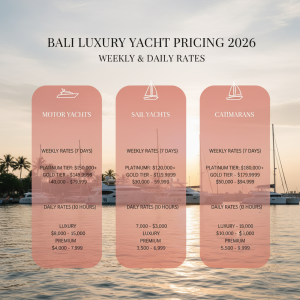
Due to their immense size, larger crews, and bespoke construction, a luxury Phinisi charter is a top-tier investment, typically ranging from $40,000 to over $150,000 per week. A high-end crewed luxury catamaran, while still a premium product, generally falls into a more accessible bracket, from $25,000 to $80,000 per week, depending on size and season.
Is a Phinisi a true sailing vessel?
Absolutely. While most charters will rely on engine power for efficient passage-making, a traditional Phinisi is a formidable sailing craft. The gaff-ketch rig is powerful, and there is no experience quite like cutting the engines and moving through the water propelled only by the wind in her seven sails. However, a catamaran will always be more nimble and sail more efficiently, especially when sailing upwind.
Where do most Bali luxury yacht charters depart from?
The primary hub for charters exploring Komodo, Lombok, and the eastern islands is Benoa Harbor in South Bali. It offers excellent facilities and is conveniently located near Ngurah Rai International Airport (DPS). For Raja Ampat itineraries, charters typically originate from Sorong in West Papua.
Ultimately, the choice between these two magnificent vessels is a reflection of your travel philosophy. Do you seek the romance of a bygone era, the grandeur of a floating palace, and the deep cultural immersion that a Phinisi provides? Or does your spirit yearn for the agile freedom, modern performance, and intimate connection to the sea that a catamaran delivers? One is a journey into history; the other is a dash toward the horizon. There is no wrong answer, only the one that resonates with the voyage you wish to create. To begin crafting your bespoke Indonesian sea voyage, explore the curated fleet of vessels offered by the Bali Luxury Yacht Bureau and let their experts match you with the perfect platform for your adventure.